
Uncovering Originality

“Even in literature and art, no man who bothers about originality will ever be original: whereas if you simply try to tell the truth (without caring twopence how often it has been told before) you will, nine times out of ten, become original without ever having noticed it.” ― C.S. Lewis, Mere Christianity
From the archives: I first published a version of this essay in April 2025 as part of my Self-Help Guru Road Trip series. Re-reading it over a year later, I found that its central question still feels relevant: What if originality isn’t about being different, but about telling the truth in your own voice?
Many readers know C.S. Lewis primarily as a Christian writer. I came to him for a different reason. His work taught me that reading someone doesn’t require agreeing with them.
C.S. Lewis was born in Ireland in 1898. His mother died just before he turned 10 years old. There are many stories about how one is forever changed if they are young when they lose a parent, and I imagine Lewis was no different, especially considering he is said to have abandoned his own faith in puberty. In his early 20s, he served in the British Army during World War I. This war claimed the life of his best friend. Lewis was discharged in 1918 and set his focus on academia. In his 30s, he left atheism and embraced theism, and later converted to Christianity. He became an influential intellect as a Fellow and Tutor in English Literature at Oxford University until 1954, when he was elected to the Chair of Medieval and Renaissance Literature at Cambridge University, where he remained until his retirement.
A friend to J.R.R. Tolkien since 1926, Lewis himself wrote more than 30 books. He often would take mythological themes or stories from the Greek and Roman classics and rework them in his prose and poetry. He took to the airways during World War II and broadcast about Christianity. These lectures are the basis for what became his publication, ‘Mere Christianity’ in 1952. This was the book that I found in my early 30s as I was reclaiming my own faith, which had also been abandoned during my teenage years. This led me to an earlier book by Lewis published in 1942, ‘The Screwtape Letters’. Written as letters from an elder demon to his protégé nephew on how to target the faithful. I really enjoyed this book, not taking from it so much in Christian viewpoints as in the comedy that Lewis created to explain how ‘the other side’ thinks. These books took away the fire and brimstone religion of my youth and replaced it with an intellectual look at how to view these ideas. They allowed me to consider that all of religion was just ideas, colored and tempered by whoever was writing or speaking the tales during whatever culture they happened to find themselves in at the time. I was not reading Lewis to gain information and absolute truths about theology. I was exploring how other people talked about their beliefs. And it opened my mind up to all the other religions of the world I was about to discover during my college education.
It may surprise you that I did not read what is perhaps C.S. Lewis’ most famous work until two years ago. In my sixties, I finally read ‘The Lion, the Witch, and the Wardrobe’. His ‘Chronicles of Narnia’ series has sold over 100 million copies and been made into a few major motion pictures. I’m not sure why I got to it so late. Especially since I was an elementary school librarian for a few years before my teaching gig. I guess it’s because by then I was aware of the religious themes of the story and I didn’t want to read that. As an older reader, I am excitedly reading and re-reading classics and I finally picked this one up. Yes, I saw the relationship to Christianity, but I appreciated instead the same elements of Lewis that I admired so long ago. His ability to combine the old stories and beliefs with a new rendering that made me think about things in a different way. I find that ability in any writer to be a main reason for my regard.
One of the traits about myself that I treasure the most is my ability to see different perspectives. If I were to only read my viewpoints, associate with people who think the same way as I do about things, or live the same lifestyle as others, I would never be able to grow, change, or improve. How boring it would be if everyone were the same! I learned this lesson from reading Lewis. He never preached to me. He never talked down to me. He never told me I had to believe as he did or his writing could not move me. In fact, he inspired me. Especially with his ability to take Greek classics and couch them in modern-day dramas and comedies while keeping their message intact. This is something I try to do with the children’s books I write. There is nothing new under the sun, so I might as well use those that are classical and have inspired so many others to continue to enthrall, educate, and enthuse new readers. This is probably what Lewis meant when he encouraged us to not ‘care a twopence’ about originality.
Perhaps originality isn’t found by searching for a voice no one has ever heard before.
Perhaps it’s found by finally using your own.
Get yourself a summer treat in my SHOP
Easy ways to practice your own self-care because you matter❣️
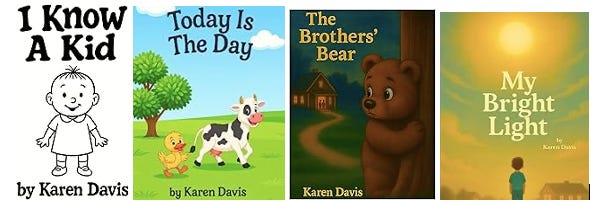
Check out my children’s books to learn more about my originality❣️
🌟 I Know A Kid — a gentle celebration of children and the many ways they move through the world.
🌟Today Is The Day — an uplifting reminder to look for what’s good, hopeful, and possible.
🌟The Brothers’ Bear — a rhyming adventure about five brothers who make an unexpected discovery one windy night.
🌟 My Bright Light — a quiet book about noticing the light around us and within us.
Subscribe for free to receive new posts and support my work, or Buy Me A Coffee and know you’re appreciated. Either way, thanks for being a part of my community❣️